

( Image: Rural Landscape, Co. Donegal )
Ireland is a country that wears its culture close to the surface. For teachers, especially those working in international or multilingual classrooms, experiencing this culture first-hand is without a doubt an enriching experience, but it can also become a powerful resource for their own teaching practice.
That is the spirit behind our Irish Culture and English Language Development programme, which blends professional language development with a journey through Irish heritage, history, and contemporary society.
Here in this blog, we explore some of the themes of the course, and why they are relevant to participants.
Language as a Living Thing
When you arrive in Ireland, one of the first things you notice is the music of the language itself. English here has its own lilt, coloured by the influence of Irish (Gaeilge). The course gives participants space to listen, reflect, and practice their own communicative English skills in this uniquely Irish environment.
The focus is on interactive skills, particularly speaking and listening, because those are the tools we most rely on to connect with others. Teachers work on pronunciation, stress timing, and strategies for giving and following instructions: practical skills they can immediately take back to their classrooms. But equally, there is a chance to step inside “Hiberno-English,” the distinctly Irish way of using English. Learn everyday expressions like “grand” (meaning fine or OK), or the familiar greeting “what’s the craic”? (meaning how are things?) colour daily conversations. These phrases, along with the rhythm and intonation of Irish English, give learners a richer sense of how the language is lived and spoken in Ireland.
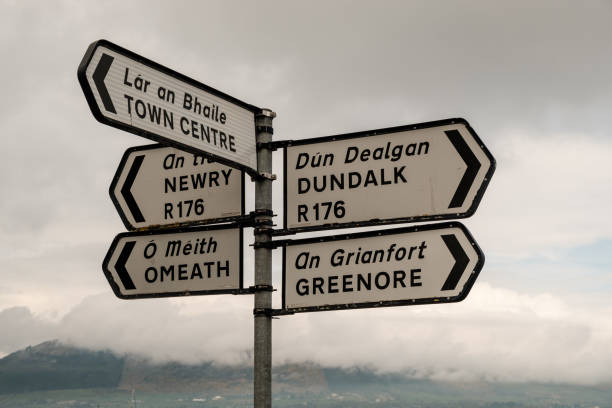
( Image: Road signage in rural Ireland, displaying English and Irish )

( Image: Aerial View Of The Hill Of Tara, Co. Meath )
Stories That Shape a Nation
Ireland is sometimes called a nation of storytellers, and with good reason. From folklore about giants and fairy forts to the works of Joyce, Yeats and Heaney, stories, myths and legends are at the heart of Irish culture. Course participants explore this tradition from multiple angles. They meet Ireland’s world-renowned writers, but also step into the oral traditions that continue to thrive. For teachers, this is also an opportunity to reflect on the role of storytelling in language learning. Story-based tasks are naturally communicative, engaging learners at all levels. Through activities such as guided discovery, flashcards, or running dictations, storytelling emerges not only as a window into culture but also as a practical classroom technique.
From Rebellion to Republic
Culture cannot be separated from history. To understand modern Ireland, it is necessary to understand the struggles that shaped it. Participants trace Ireland’s path from rebellion and civil war to independence and the modern Republic.
These sessions invite teachers to explore how social and economic changes have shaped people’s lives. What does independence mean in everyday terms? How has emigration shaped family identities across the world? And what does it mean for a small island to suddenly become one of Europe’s fastest-growing economies in the 21st century?
By engaging with these themes, teachers can broaden their own cultural awareness but also see how history can be taught in accessible, communicative ways. Complex events are broken down into meaningful stories that connect with learners.

( Image: General Post Office (GPO), O’Connell Street, Dublin )

( Image: A Crowd Attending An Outdoor Music Festival )
The Soundtrack of a People
Few things capture Ireland’s spirit like its music and dance. Traditional sessions with fiddles, flutes, and bodhráns still animate pubs across the country. But Ireland has also left its mark on global music, influencing rock, pop, hip hop, and punk.
On the course, participants explore these traditions hands-on, discovering how rhythm, melody, and movement can also become tools for language teaching. Dance, for example, naturally integrates instructions, sequencing, and vocabulary around movement. Music opens opportunities for stress, rhythm, and pronunciation practice.
The Irish Abroad
No story of Ireland would be complete without the Irish abroad. From pirates to politicians, scientists to sports stars, Ireland’s diaspora has shaped the world in surprising ways. These stories connect participants to a broader idea of Irishness, one that is not limited by geography.
For teachers working in international contexts, this perspective is particularly valuable. It highlights how migration, identity, and belonging are themes that resonate with learners everywhere. By exploring Irish emigration, teachers also find pathways to connect with their own students’ experiences of cultural exchange and identity.

( Image: General Post Office (GPO), O’Connell Street, Dublin )

( Image: Adult Students Studying Together )
Learning by Doing
The methodology is as important as the content. The course models popular classroom techniques such as think-pair-share, running dictation, and guided discovery so that participants experience them as learners before reflecting on them as teachers.
This hands-on approach is especially powerful for those who want to bring more communicative practice into their own classrooms. Teachers have the opportunity to improve their English but in addition, leave with a refreshed toolkit of strategies for engaging students.
Why Does Learning About Other Cultures Matter?
In a globalised world, language teaching is no longer just about grammar and vocabulary. It is about communication, culture, and connection. When teachers return from Ireland, they do not just take home stronger English skills. They carry with them stories of Irish history, music, literature, and community: stories they can share with their own students.
For many, the biggest outcome is confidence: confidence to use English more fluently, confidence to bring culture into the classroom, and confidence to keep developing as
Past Participant Feedback
“It was my first experience in an English course in Dublin, especially a course about Irish Culture, it was amazing. I was with my three colleagues from Italy and we are all teachers, and we learned a lot about Irish Culture. I knew some things, but not much, but now I know everything about Irish Culture… I visited St. Patrick’s Cathedral, I went to the National Gallery, and especially at school, the course was amazing, the teacher was great and funny. I learned a lot about Irish dances. It was my favourite activity to do, the Irish dances…I recommend this course to everybody. I really recommend others come to this school, to ATC Dublin, they are all very welcoming.”
Lorenza from Italy, July 2025
Where Can You Take This Course?
The course itself takes place in person at ATC Dublin and ATC Bray. Dublin, the capital, offers a vibrant mix of history, literature, and contemporary culture on every corner. Bray, with its seafront promenade and views of the Wicklow Mountains, provides a quieter but equally inspiring setting.
International groups come together on scheduled dates, creating a community of teachers from across Europe and beyond. For schools wishing to send a closed group, the course can be arranged at flexible times throughout the year. The programme is intensive but rewarding: 20 hours of in-person training combined with 10 hours of project work, making a full-time 30-hour week. Participants leave with a certificate recognising their development, but perhaps more importantly, with experiences and ideas they can carry into their future teaching.